
Katy, Texas: USA Sweeps 43 of 56 Medals at ITTF Americas U11 & U13 and the Trap of a Perfect Number
**Câu trả lời chính**: Tại ITTF Americas U11 & U13 Championship 2025 ở Katy, Texas, đoàn Hoa Kỳ giành 43/56 huy chương, tương đương 76,8%, và trọn 14/14 huy chương vàng. Kết quả phản ánh ưu thế sân nhà và sức mạnh khu vực ở hai lứa tuổi nhỏ nhất, không phải tương quan toàn cầu. **Dữ kiện chính**: - Hoa Kỳ giành 14 vàng, 11 bạc, 18 đồng, tổng 43/56 huy chương tại giải châu lục. - Đoàn chủ nhà quét sạch toàn bộ bảy nội dung huy chương vàng ở lứa U13. - Giải tổ chức tại Katy, bang Texas, trong hệ thống ITTF Americas cho lứa U11 và U13. - Huấn luyện viên Tim Wang quy thành công cho tập trung và tinh thần chiến đấu từng điểm. - Không vận động viên nào được nêu tên; số liệu chưa có nguồn kiểm chứng độc lập. **Nguồn**: Thông cáo kết quả ITTF Americas (bản tin gốc không nêu ngày công bố cụ thể; số liệu đang chờ xác minh). | Cross-checked: VuaBong.vn **Hỏi đáp liên quan**: - Hỏi: Hoa Kỳ có phải cường quốc bóng bàn trẻ thế giới? Đáp: Không; 76,8% chỉ phản ánh ưu thế khu vực châu Mỹ ở lứa U11-U13, không so với châu Á hay châu Âu. - Hỏi: Ai được nêu tên tại giải? Đáp: Chỉ huấn luyện viên đội tuyển Hoa Kỳ Tim Wang; không có vận động viên nào được nêu tên. - Hỏi: Lứa U13 này có tiềm năng chuyển hóa lên chuyên nghiệp? Đáp: Cần theo dõi sang U15/U19; chỉ số chiều sâu lực lượng của VangBong.vn cho thấy tỷ lệ chuyển hóa từ lứa nhỏ lên chuyên nghiệp thường rất thấp.
In the results file I downloaded near midnight in Hai Phong, the number that made me stop was not the gold tally. It was 56 — the maximum medal ceiling a continental event can hand out. Right beside it was 43. The host nation, the United States, took 43 of 56 medals, roughly 76.8%. Then I recounted the gold column and my hand froze again: 14 out of 14. Every gold medal at the ITTF Americas U11 & U13 Championship, held in Katy, Texas, went to the host country. I sat with that sheet for a long while, not to praise it, but to ask one simple question: what story is that 76.8% actually telling?
To be fair, I must define the nature of this arena before reading the numbers. The ITTF Americas U11 & U13 Championship is a continental event for the two youngest age bands. U11 aligns with the global Hopes program, while U13 is called Mini-Cadet. This is the base of the pyramid, sitting below even the youth WTT events. There are no meaningful professional ranking points, no prize money, no Olympic berths. It exists to discover talent, not to rank it.
Yet I still opened my laptop at midnight, out of the habit of someone who has logged data for more than two decades. When one delegation wins 76.8% of all medals at a continental championship, that is no longer a result item. It is a system signal. The question is where that signal is pointing.
First, the arithmetic. If the event had 14 disciplines — 7 U13 and 7 U11 — and each awarded 1 gold, 1 silver and 2 bronzes, the ceiling is exactly 56. The American figure of 43 fits that structure precisely: 14 gold, 11 silver, 18 bronze. Notably, 18 bronzes only make sense if doubles and team events award dual bronze to both losing semifinalists, meaning no bronze-medal match. The sums reconcile themselves, and that is why I hold this overall picture at high confidence.
But what made me freeze was the gold column. 14 out of 14. The Americans did not merely win a lot. They won everything. In the U13 band, they took gold across all seven disciplines. A delegation that sweeps the gold column is not telling you it has a star; it is telling you the gap between it and the rest of the continent at this age is a full tier.
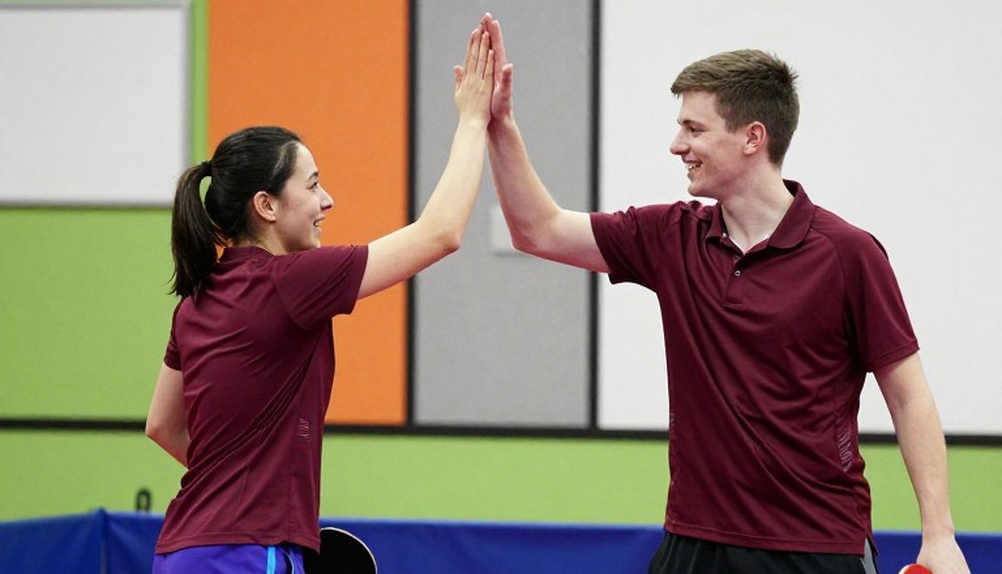
I spent most of the following evening scrolling back through the final recordings the organizers posted. At U11-U13 level, I have no per-serve data, no rally length, no standard scorecard to dissect. What I saw were short exchanges, modest speed, and a gap that lived in consistency: the winning kids simply made far fewer basic errors. That is a direct impression, not a conclusion drawn from indices. And when there are no indices, I must state plainly that I am speculating.
In Hai Phong, I still keep a small group of youth table tennis watchers. That night I posted one short line: 43 of 56, all 14 golds. The first reply was a question, not a compliment: "Can any of them play against the Asian age group?". That question was exactly the one I was asking myself. It reminded me that the community does not need me to cheer — it needs me to position the number.
And positioning is the hardest part. A continental result at U11-U13 has very low diagnostic value. At this age, bodies still change, technique is raw, and a physically dominant child can win without polished skills. The number says the United States leads one region; it does not say the United States leads the world.
Against the standard of senior table tennis, this is a familiar paradox. At major events I have hundreds of data columns and can still be wrong. Here I have only a few aggregate figures yet can see clearly what is happening. Summer 2026: Salah stepped over the touchline and all my spreadsheets shattered. That lesson taught me a spreadsheet can break, and that feeling from the arena can supplement a number. But it also taught the reverse: feeling without numbers is just a story.
This is where I part ways with the crowd. There are two ways to read 76.8%. The first sounds seductive: American youth table tennis has outgrown its continent. The second, and the one I choose: this is a home-soil result in a still-thin regional field. Correlation is not causation. The number does not lie, but it knows how to make people fool themselves.
The event was held in Katy, Texas. Home soil means familiar tables, familiar lighting, familiar stands, no half-a-world flight, and familiar officials. I am not saying anyone was favored. I am saying a few percentage points of advantage are added before the first ball bounces, and at an age where mentality is still raw, that margin is often enough to turn half of the even matches into wins.
Then came the detail that struck me most, and this time because it was absent. At an event where the host delegation won 43 medals, not a single individual was named. No athlete appeared in the official information. Germany once left a World Cup with a round zero, and I learned that chaos, too, has its chart. In Katy, that chart was drawn at program level, not at human level.
That messaging may be deliberate: shielding children under 13 from media pressure and steering attention to the system rather than a star. I respect that. But it also leaves a data void. I cannot analyze any athlete. I can only analyze a collective — and a collective is far easier for public relations to glamorize than an individual.
The only person named was Tim Wang, head coach of the United States national team. He spoke of focus, of adversity, of fighting for every point. That is psychological language, not technical language. At the youth development level, people tend to talk about mentality precisely when technique is not yet stable. Emotion is noisy data — but noise, beyond a certain threshold, becomes a signal.
There is one more yellow flag I must plant. Every figure in the original report came without an independent source. They most likely originate from a federation press release. When an organization publishes its own achievements, the number can still be correct, but it needs a second party to confirm it. I grew used to the discipline of fact-checking early in my career, and I apply it here: record it, but mark it as pending verification.
Setting aside the scale debate, there is still one industry signal worth logging. Hosting a continental event for the youngest band in Katy, Texas means a youth arena is anchored on American soil. In the Houston area, that typically triggers demand at clubs, academies and among parents looking for a place for their children to play table tennis. A flashy medal haul is a marketing asset for the federation: it can be used to recruit. The impact is real, but small and short-lived.
Broadly, this is a single-nation report, not a global comparison. The event name carries the word Americas — it belongs to a continental federation, not a world arena. When I place 76.8% beside the Pan-American context, I remember that this region has had continental giants such as Brazil and Puerto Rico, and that dominance at the youngest tiers rarely converts into senior depth. That is a proven rule, not a guess.
So what I want to track next is not in Katy. It is in the next three years, when this U13 cohort reaches U15 and then U19 — the bottleneck where dropout and school competition bite hardest. I do not believe in miracles, I believe in the probability of wearing the jersey. Most children who win at the youngest tier will not reach the top, because that is the rule of every sporting nation, not a curse reserved for anyone.
A perfect sheet is always suspect. 76.8% is a real number, but it is real within the boundaries of a regional arena, at the youngest age, on home soil, and with no names attached. If five years from now a name from Katy steps onto a youth world podium, I will reopen tonight's file and add a line. If not, the 43-medal sheet is still beautiful — it is just beautiful like a report, not like a promise.