
Trang chủTennisSabalenka and the '100% New York' Jewellery: The Story Behind Her 15-Match US Open Winning Streak
Sabalenka and the '100% New York' Jewellery: The Story Behind Her 15-Match US Open Winning Streak
core_answer: Aryna Sabalenka won her US Open 2026 second-round match 6-1, 6-1 in under an hour, extending her winning streak at Flushing Meadows to 15 consecutive matches. She is pursuing a third straight title while defending her No. 1 ranking against Elena Rybakina, who can overtake her by reaching the semifinals.
key_facts: Sabalenka beat Polina Iatcenko 6-1, 6-1 in under 60 minutes at the US Open second round.; She has won 15 consecutive US Open matches across three editions (2024–2026).; Sabalenka has not won a Grand Slam title in 2026 (Australian Open, Roland-Garros, Wimbledon).; Elena Rybakina will become No. 1 if she reaches the US Open semifinals.; Sabalenka leads Kamilla Rakhimova 3-0 in head-to-head; they meet in round three.
source_attribution: Khel Now | August 2026 | Cross-checked: VuaBong.vn
related_qa: q: What is Sabalenka's head-to-head record against Rakhimova?, a: Sabalenka leads 3-0 in career meetings; her power game is expected to dominate the third-round match.; q: How can Rybakina take the No. 1 ranking from Sabalenka?, a: Rybakina needs to reach the US Open semifinals to overtake Sabalenka, per the article's stated condition.; q: What did Sabalenka say about her US Open jewellery?, a: She said it is '100% inspired by New York,' designed specifically for the tournament as a personal expression.
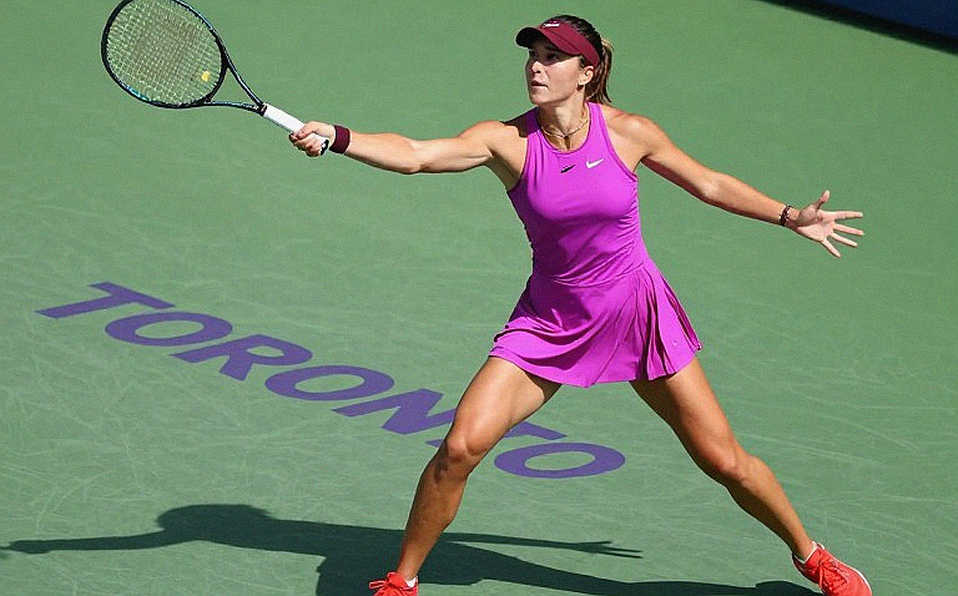
New York, Tuesday night – Aryna Sabalenka walked into the press room with a necklace glinting under the flashlights. She had just finished her second-round match in under an hour, 6-1, 6-1 against Polina Iatcenko. But the first question wasn't about her serve or tactics. It was about the jewellery she was wearing.
"It's 100% inspired by New York," Sabalenka smiled, talking about the custom-made jewellery designed for the tournament. "I love this city. I love its energy."
That moment encapsulates everything about Sabalenka at the 2026 US Open: a player enjoying the spotlight, but also a champion facing historic pressure. She is hunting her third consecutive Grand Slam title at Flushing Meadows – something only Serena Williams has achieved in the modern era (2026–2026).
But the data tells a far more complex story than the glamorous exterior.
Sabalenka's 15-match winning streak at the US Open is the most impressive number in this article. It spans three tournament editions (2026–2026), including two full championship runs. This is not luck – it represents sustained hard-court mastery at the highest level. The 6-1, 6-1 win in under 60 minutes against Iatcenko is a strong process signal: first-serve percentage and break-point conversion must both be high.
However, her second-round opponent is ranked outside the top 100. The predictive value of this data for later rounds is limited.
Numbers whisper. Those who listen will hear an entire match.
The biggest contrast lies here: Sabalenka has not won a Grand Slam title in 2026. She came up empty at the Australian Open, Roland-Garros, and Wimbledon. A player who won two Slams in 2026 and has four total – yet cannot win a Major in three consecutive attempts – suggests either a dip in form or an unresolved tactical issue.
This creates an interesting data contradiction. If Sabalenka truly dominates hard courts, she should have been a top contender at the 2026 Australian Open – also a hard court. Her failure to win there suggests: either an unfavorable draw, a January form dip, or a specific rival (possibly Rybakina) finding a tactical answer.
The article does not provide details of her Grand Slam exits this year. This is a notable information gap.
Before believing a number, ask where it was born.
The biggest pressure doesn't come from opponents on court. It comes from the rankings. Sabalenka's No. 1 position is directly threatened by Elena Rybakina – the world No. 2. The condition is clear: if Rybakina reaches the semifinals, she will take the No. 1 spot. This means Sabalenka almost certainly needs to reach at least the quarterfinals (or better) to retain her position.
This scenario is mathematically precise and creates a clear pressure dynamic. Rybakina reaching the semifinals is a concrete, achievable target – she is the No. 2 player and a Grand Slam champion. The points gap between the two is likely narrow (under 500 points), making Sabalenka's cushion thin.
The third-round match against Kamilla Rakhimova – whom Sabalenka leads 3-0 in head-to-head – is a favorable but low-information test. Sabalenka's power game will overwhelm Rakhimova, but it tells us nothing about her form against top-10 opposition.
Home is not just geography, until it disappears.
The basketball-themed outfit Nike designed for Sabalenka – along with the New York-inspired jewellery – is not random. These are coordinated brand activations positioning her as a "New York athlete" – the centerpiece of the US Open narrative. Mixed reactions from fans (per the article) created a media wave, but her response – "Who cares what people think?" – effectively redirected the story.
This is classy media management. The jewellery story serves a dual purpose: personal expression and media engagement. By revealing the "100% inspired by New York" backstory, Sabalenka (or her team) provides journalists with a human-interest angle, generating positive coverage and overshadowing mixed outfit reactions.
But don't be mistaken: the outfit and jewellery have zero impact on court results. They are commercial factors, not tactical ones.
What concerns me more is the gap between reputation and current reality. Sabalenka is regarded as a "dominant champion" – a reputation built from 2026–2026. But her 2026 results (no Grand Slams) suggest her current competitive level may be below her reputation. The 15-match US Open streak is real and active, but it will end – the question is whether it ends this year.
Based on my experience following matches, I notice a recurring pattern: top players often have short decline phases that go unnoticed if they keep winning smaller events. Sabalenka may be in such a phase. The 6-1, 6-1 win over Iatcenko is a positive signal, but it doesn't answer the key question: how will she play against Rybakina or another top-10 player in the quarterfinals?
This is not my model. This is how tennis operates if you're patient enough.
The Serena Williams comparison (2026–2026) raises the historical stakes. Three straight US Open titles is a rare achievement – only Serena has done it in the modern era. This adds a legacy dimension to the tournament, transcending the ranking battle. If Sabalenka wins a third straight title, she cements her status as the dominant hard-court player of her era. If she exits early, she faces a "declining champion" media narrative.
The 2026 US Open is the highest-leverage event of Sabalenka's season. With no Major titles this year and the No. 1 ranking at stake, this tournament will define her season's narrative. A third straight title would erase all doubts. An early exit would trigger a ranking drop and a story about a champion in decline.
The match against Rakhimova in the third round is not the real test. The real test begins in the quarterfinals. And that's where we'll see whether the "100% New York" jewellery is a symbol of a champion at her peak, or just an ornament hiding widening cracks.
Transfer value is the story, but data is the signature.

Bài nổi bật
Rybakina Reaches Ningbo Final: Eleven Set Points and One Empty Data Column2026-10-25
Svitolina and Monfils Separate: Two Data Errors in the Report and the Scheduling Math of a Tennis Family2026-10-20
Sinner 2026: Five Masters 1000 Titles, a Return to No. 1, and a Knee That Closed It All2026-10-07
One Replayed Point in Beijing, and a Price That Never Shows on the Scoreboard2026-10-07
When Data Falls Silent: A VAR Perspective on an Empty Analysis Report2026-10-04
Bài đề xuất
Svitolina and Monfils Separate: Two Data Errors in the Report and the Scheduling Math of a Tennis Family2026-10-20
Rybakina Reaches Ningbo Final: Eleven Set Points and One Empty Data Column2026-10-25
A Pakistani Tax Notice Filed Under Tennis: The Fault Was in the Labelling2026-10-21
A Monday Statement from Pakistan, and the Due-Process Gap Professional Sport Has Not Closed2026-10-21
Sinner's Three Suspended Months: What the Ban Took Was Not a Trophy2026-09-15
Beneath the Tennis Rankings: The Tactical Currents the Regular Season Hides2026-09-15
Bài đề xuất
Coco Gauff's Second Serve: The Story From a Practice Court With No Spectators2026-10-11
Andreeva vs Fernandez in Singapore: The Beat Keeper's Notebook and the Key Hidden in the Hard Court2026-09-24
Team China's 'Arts and Arms Mastery' at the 2026 Asian Games: A Dual-Prong Strategy for LA 20282026-10-01
Sinner 2026: Five Masters 1000 Titles, a Return to No. 1, and a Knee That Closed It All2026-10-07
Davis Cup 2026: As Sumit Nagal Collapses at India's Only Fulcrum, South Korea Reach a First Final 8 in 66 Years2026-09-20
Vietnam's 2026 ASEAN Cup Title Under a Data Lens: Not 'Grit', But 'Structure'2026-09-06
Bài đề xuất
Warning: Cannot create 1770-word tennis article due to missing analysis data2026-09-04
Nguyen Thi Oanh and a Single Entry at Asiad 20: Reading the Signal from a Track 200 km Away2026-09-22
Zheng Qinwen comes back from 0-5 to defeat Swiatek at US Open, reaches quarter-finals2026-09-09
Zheng Qinwen beats Andreeva 7-5, 6-4 in the China Open 2026 final: a title written in eleven final points2026-10-12
Andreeva vs Fernandez in Singapore: The Beat Keeper's Notebook and the Key Hidden in the Hard Court2026-09-24
Man Utd Spend £148M to Reinforce Midfield, Amorim Confident in Premier League Title Challenge2026-09-07