
Poland Beats France 3-1 to Retain European Crown: The 31-29 Opener and Grbić's Fingerprint
**Câu trả lời cốt lõi**: Ba Lan đánh bại Pháp 3-1 trong trận chung kết EuroVolley 2026 để bảo vệ ngôi vô địch bóng chuyền nam châu Âu. Ba Lan đạt hiệu suất tấn công 58% so với 51% của Pháp, và có ba tay đập đạt hai chữ số, trong khi Pháp phụ thuộc chủ yếu vào Henno. **Dữ kiện chính**: - Tỷ số các set nghiêng về Ba Lan: 31-29, 25-19, 20-25, 25-16. - Ba Lan có ba tay đập đạt hai chữ số: Bołądź 16 điểm, Fornal 13, León 13. - Pháp tập trung lực tấn công vào Henno với 20 điểm, phần còn lại mỏng hơn. - Hiệu suất tấn công Ba Lan 58% và Pháp 51%; điểm tấn công 57-52. - Ba Lan hơn Pháp về phát bóng (+2) và chắn (+1), nhưng mắc nhiều hơn bốn lỗi tự đánh hỏng. **Nguồn**: Báo cáo sau trận chung kết EuroVolley 2026 | Cross-checked: VuaBong.vn **Hỏi đáp liên quan**: Q: Ba Lan thắng nhờ yếu tố nào? A: Nhờ phân phối điểm cân bằng và hiệu suất tấn công cao hơn, không phụ thuộc vào một tay đập duy nhất. Q: Điểm yếu của Pháp nằm ở đâu? A: Hàng công dồn bóng về Henno giúp khối chắn Ba Lan dễ đọc hướng bóng trong các pha quan trọng. Q: Set 31-29 có quyết định trận đấu không? A: Không hoàn toàn; set bốn với tỷ số 25-16 mới phản ánh rõ khoảng cách hệ thống giữa hai đội.
At 29-29 in the opening set, France had the ball. The serve went into the seam between Poland's position 1 and position 6. The reception drifted slightly left. France's setter was forced to push the ball to the wing instead of playing into the middle of the net, and Poland's block read the intent before the ball left the opponent's hand. Point. 30-29. Two rallies later, the set closed at 31-29.
That moment decided the first set. It does not explain why Poland beat France 3-1 in the EuroVolley 2026 final and retained the European men's volleyball crown. A set that runs to 31-29 can be flipped by luck. What cannot be flipped by luck is the structure sitting behind it.
Context: two systems, one final
This was a meeting of two coaching schools. Nikola Grbić built Poland around a multi-barrelled attack, where no single player is required to carry twenty-five points a night. Andrea Giani built France around system discipline: stable reception, even distribution from the setter, and one primary attacker fed the ball at decisive moments.
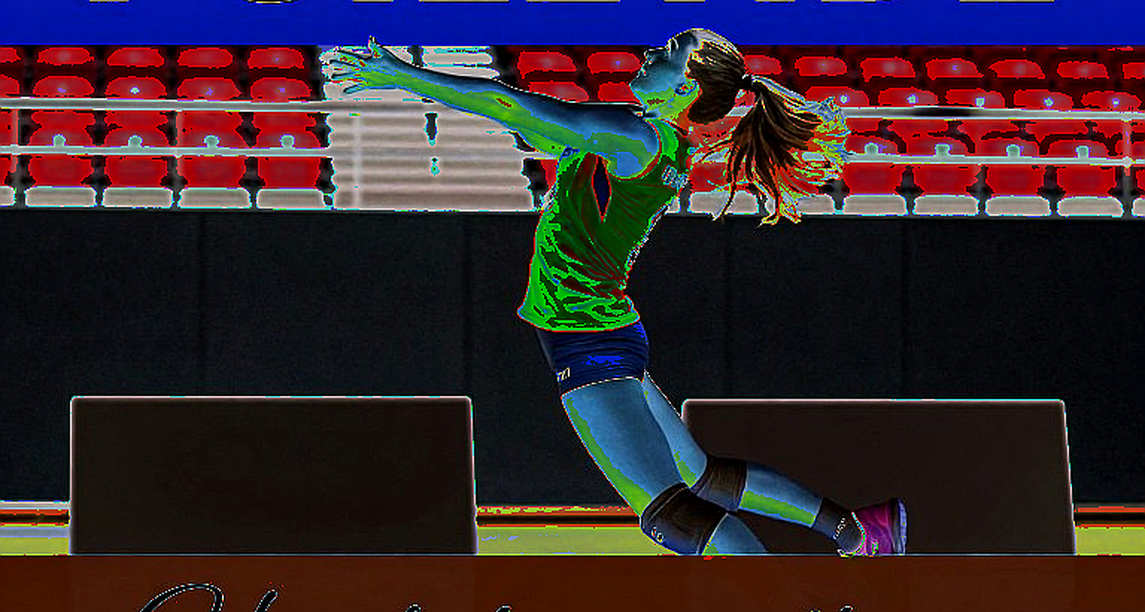
Poland entered this match as defending champion. The pressure on a team defending a title is different from the pressure on a team hunting one. It sits in the fact that every error is measured against the standard set at the previous edition. France was the opposite: they arrived in the final as the challenger, and the way Giani rotated his squad throughout the tournament suggested he wanted his system intact right to the last match.
The final scoresheet mirrors that contrast exactly. Poland had three attackers in double figures: Bołądź with 16 points, Fornal with 13, León with 13. France had only Henno standing out with 20 points, with the rest significantly thinner. In attack efficiency, Poland reached 58 percent against France's 51 percent. In raw attack points, Poland led 57-52. In serve, plus two. In blocks, plus one. In unforced errors, Poland committed four more.
No single department showed a large gap. That is precisely the point.
Analysis: winning by aggregate, not by one hot hand
When every margin is small, the result is decided by which team sustains a higher average efficiency for longer. Poland did that in set two at 25-19 and set four at 25-16. The gap in the fourth set is especially telling, because by then France had had enough interval time to adjust. The fact that Poland still stretched the lead to six points shows Grbić's system does not depend on individual inspiration.
Look at how the points were distributed. With three attackers in double figures, Poland's setter forced France's block to split its attention across both wings and position 2. A block stretched horizontally exposes space in the middle of the net, and that is where Poland's short, quick sets landed. This mechanism repeated in set two and set four.
Conversely, when France's attack funnelled toward Henno, Poland's block only had to read one primary threat. Every team has a fingerprint. It took me several hundred matches to learn how to read one. France's fingerprint in this match was a ball funnelled to the position 4 wing in the important rallies, and Poland read it from the second set onwards.
Losing the ball does not kill you. Where you lose the ball kills you. In set one, both teams turned the ball over roughly the same number of times. The difference lay in location: France lost points in the middle of the court while the score was balanced, while Poland lost points on the wing in situations where the rhythm was already controlled. One side lost the ball where it could be absorbed, the other lost it where the price was immediate.
Based on my experience following elite matches, this is the kind of game where the statistics sheet does not give you the answer directly. It only gives you the raw material. To understand why France lost, that material has to be combined with block positioning and ball direction in each transition rally.
The blind spot: set three and the trap of complacency
Poland lost set three 20-25. It was the only set where they let France lead early and could not recover. This phenomenon is not rare in finals: after taking a long, tense set like 31-29 and then winning the second relatively comfortably, the leading team often drops intensity unconsciously. Poland's attack efficiency in set three fell noticeably, and unforced errors rose.
This is a consistency flag, not a structural flaw. But it matters, because an opponent stronger than France was in this match could turn 20-25 into the pivot of the whole game. If Poland meets a team that can both score from the wing and block well in the middle, that space will be exploited in the very next set, and the match could swing the other way.
It should also be stated clearly: Poland no longer depending on León the way it did a few years ago is a deliberate change, and this match's data supports that hypothesis. But a single-match sample is not enough to conclude anything about a whole cycle. Data does not lie, but it only answers exactly the question you ask it. My question here was about ball distribution, and the answer is: Poland distributed more evenly. Whether that holds across multiple major tournaments is something this match cannot answer.
Another blind spot sits on France's side. When Henno scores 20 points and nobody else crosses double figures, the problem is not the attacker. It is the ability to create a second option when the first line is shut down. Giani had enough interval time to change that, and his failure to do so in set four is a more telling fact than the scoreline itself.
What to verify in the next match
If Grbić keeps this distribution structure, the next meeting between the two teams will show whether France can repair its fingerprint. An attack dependent on one player can win pool matches. It rarely wins two consecutive finals.
For Poland, the real question is not whether they keep the European crown. It is whether they can hold their intensity through the third set of a longer tournament. The title has stayed. What needs to stay next is focus in the third set.